 |
We are immortal, I know it sounds like a joke. I know because I met the exception to the rule, I know the only mortal there is. He told me his story in a bar in the rue Cambronne, drunk enough so it didn’t bother him to tell the truth, even though the bartender (who owned the place) and the regulars at the counter were laughing so hard that the wine was coming out of their eyes. He must have seen some flicker of interest in my face—he drifted steadily toward me and we ended up treating ourselves to a table in the corner where we could drink and talk in peace. He told me that he was a retired city employee and that his wife had gone back to her parents for the summer, as good a way as any of letting it be known that she’d left him. He was a guy, not particularly old and certainly not stupid, with a sort of dried-up face and consumptive eyes. In honesty, he was drinking to forget, a fact which he proclaimed by the time we were starting the fifth glass of red. But he did not smell of Paris, that signature of Paris which apparently only we foreigners can detect. And his nails were decently pared, no specks under them.
He told how he’d seen this kid on the number 95 bus, oh, about thirteen years old, and after looking at him for a spell it struck him that the boy looked very much like him, at least very much as he remembered himself at that age. He continued little by little admitting that the boy seemed completely like him, the face, the hands, the mop of hair flopping over the forehead, eyes very widely spaced, even more strongly in his shyness, the way he took refuge in a short-story magazine, the motion of his head in tossing his hair back, the hopeless awkwardness of his movements. The resemblance was so exact that he almost laughed out loud, but when the boy got down at the rue de Rennes, he got off too, leaving a friend waiting for him in Montparnasse. Looking for some pretext to speak with the kid, he asked directions to a particular street, and without surprise heard himself answered by a voice that had once been his own. The kid was going as far as the street, and they walked along together shyly for several blocks. At that tense moment, a kind of revelation came over him. Not an explanation, but something that could dispense with explanation, that turned blurred or stupid somehow when—as now—one attempted to explain it.
To make a long story short, he figured a way to find out where the kid lived, and with the prestige of having spent some time as a scoutmaster, he managed to gain entrance to that fortress of fortresses, a French home. He found an air of decent misery, a mother looking older than she should have, a retired uncle, two cats. Afterward, it was not too difficult; a brother of his entrusted him with his son who was going on fourteen, and the two boys became friends. He began to go to Luc’s house every week; the mother treated him to heated-up coffee, they talked of the war, of the occupation, of Luc also. What had started as a blunt revelation was developing now like a theorem in geometry, taking on the shape of what people used to call fate. Besides, it could be said in everyday words: Luc was him again, there was no mortality, we were all immortals.
“All immortals, old man. Nobody’d been able to prove it, and it had to happen to me, and on a 95 bus. Some slight imperfection in the mechanism, a crimp and doubling back of time, I mean an overlap, a re-embodiment incarnate, simultaneously instead of consecutively. Luc should never have been born until after I’d died, and on the other hand, I … never mind the fantastic accident of meeting him on a city bus. I think I told you this already, it was a sort of absolute surety, no words needed. That was that, and that was the end of it. But the doubts began afterwards, because in a case like that, you either think that you’re an imbecile, or you start taking tranquilizers. As for the doubts, you kill them off, one by one, the proofs that you’re not crazy keep coming. And what made those dopes laugh the hardest when, once in a while, I said something to them about it, well, I’ll tell you now. Luc wasn’t just me another time, he was going to become like me, like this miserable sonofabitch talking to you. You only had to watch him playing, just watch, he always fell down and hurt himself, twisting a foot or throwing his clavicle out, flushes of feeling that’d make him break out in hives, he could hardly even ask for anything without blushing horribly. On the other hand his mother would talk to you about anything and everything with the kid standing there squirming with embarrassment, the most incredible, intimate, private … anecdotes about his first teeth, drawings he made when he was eight, illnesses … she liked to talk. The good lady suspected nothing, that’s for sure, and the uncle played chess with me, I was like family, even lending them money to get to the end of the month. No, it was easy to get to know Luc’s history, just edging questions into discussions his elders were interested in: the uncle’s rheumatism, politics, the venality of the concierge, you know. So between bishop calling check to my king and serious discussions of the price of meat, I learned about Luc’s childhood, and the bits of evidence stockpiled into an incontrovertible proof. But I want you to understand me, meanwhile let’s order another glass: Luc was me, what I’d been as a kid, but don’t think of him as the perfect copy. More like an analogous figure, understand? I mean, when I was seven I dislocated my wrist, with Luc it was the clavicle, and at nine I had German measles and he had scarlet fever, the measles had me out some two weeks, Luc was better in five days, well, you know, the strides of science, etc. The whole thing was a repeat and so, give you another example somewhat to the point, the baker on the corner is a reincarnation of Napoleon, and he doesn’t know because the pattern hasn’t changed, I mean, he’ll never be able to meet the real article on a city bus; but if in some way or another he becomes aware of the truth, he might be able to understand that he’s a repeat of, is still repeating Napoleon, that the move from being a dishwasher to being the owner of a decent bakery in Montparnasse is the same pattern as the jump from Corsica to the throne of France, and that if he dug carefully enough through the story of his life, he’d find moments that would correspond to the Egyptian Campaign, to the Consulate, to Austerlitz, he might even figure that something is going to happen to his bakery in a few years and that he’ll end on St. Helena, say, some furnished room in a sixth-floor walkup, a big defeat, no? and surrounded by the waters of loneliness, also still proud of that bakery of his which was like a flight of eagles. You get it?”
Well, I got it all right, but I figured that we all get childhood diseases about the same time, and that almost all of us break something playing football.
“I know, I haven’t mentioned anything other than the usual coincidences, very visible. For example, even that Luc looked like me is of no serious importance, even if you’re sold on the revelation on the bus. What really counted was the sequence of events, and that’s harder to explain because it involves the character, inexact recollections, the mythologies of childhood. At that time, I mean when I was Luc’s age, I went through a very bad time that started with an interminable sickness, then right in the middle of the convalescence broke my arm playing with some friends, and as soon as that was healed I fell in love with the sister of a buddy of mine at school, and God, it was painful, like you can’t look at a girl’s eyes and she’s making fun of you. Luc fell sick also, and just as he was getting better they took him to the circus, and going down the bleacher seats he slipped and dislocated his ankle. Shortly after that his mother came on him accidentally one afternoon with a little blue kerchief twisted up in his hands, standing at a window crying: it was a handkerchief she’d never seen before.”
As someone has to be the devil’s advocate, I remarked that puppy love is the inevitable concomitant of bruises, broken bones and pleurisy. But I had to admit that the business of the airplane was a different matter. A plane with a propeller driven by rubber bands that he’d gotten for his birthday.
“When he got it, I remembered the erector set my mother gave me as a present when I was fourteen, and what happened with that. It happened I was out in the garden in spite of the fact that a summer storm was ready to break, you could already hear the thunder cracking, and I’d just started to put a derrick together on the table under the arbor near the gate to the street. Someone called me from the house and I had to go in for a minute. When I got back, the box and the erector set were gone and the gate was wide open. Screaming desperately, I ran out into the street and there was no one in sight, and at that same moment a bolt of lightning hit the house across the road. All of this happened as a single stroke, and I was remembering it as Luc was getting his airplane and he stood there gazing at it with the same happiness with which I had eyed my erector set. The mother brought me a cup of coffee and we were trading the usual sentences when we heard a shout. Luc had run to the window as though he were going to throw himself out of it. His face white and his eyes streaming, he managed to blubber out that the plane had swerved in its trajectory and had gone exactly through the small space of the partly opened window. We’ll never find it again, we’ll never find it again, he kept saying. He was still sobbing when we heard a shout from downstairs, his uncle came running in with the news that there was a fire in the house across the street. Understand now? Yes, we’d better have another glass.”
Afterward, as I was saying nothing, the man continued. He had begun thinking exclusively of Luc, of Luc’s fate. His mother had decided to send him to a vocational school, so that what she referred to as “his life’s road” would be open to him in some decent way, but that road was already open, and only he, who would not have been able to open his mouth, they would have thought him insane and kept him away from Luc altogether, would have been able to tell the mother and the uncle that there was no use whatsoever, that whatever they might do the result would be the same, humiliation, a deadly routine, the monotonous years, calamitous disasters that would continue to nibble away at the clothes and the soul, taking refuge in a resentful solitude, in some local bistro. But Luc’s destiny was not the worst of it; the worst was that Luc would die in his turn, and another man would relive Luc’s pattern and his own pattern until he died and another man in his turn enter the wheel. Almost as though Luc were already unimportant to him; at night his insomnia mapped it out even beyond that other Luc, to others whose names would be Robert or Claude or Michael, a theory of infinite extension, an infinity of poor devils repeating the pattern without knowing it, convinced of their freedom of will and choice. The man was crying in his beer, only it was wine in this case, what could you do about it, nothing.
“They laugh at me now when I tell them that Luc died a few months later, they’re too stupid to realize … Yeah, now don’t you start looking at me like that. He died a few months later, it started as a kind of bronchitis, like at the same age I’d come down with a hepatitis infection. Me, they put in the hospital, but Luc’s mother persisted in keeping him at home to take care of him, and I went almost every day, sometimes I brought my nephew along to play with Luc. There was so much misery in that house that my visits were a consolation in every sense, company for Luc, a package of dried herrings or Damascus tarts. After I mentioned a drugstore where they gave me a special discount, it was taken for granted when I took charge of buying the medicines. It wound up by their letting me be Luc’s nurse, and you can imagine how, in a case like that, where the doctor comes in and leaves without any special concern, no one pays much attention if the final symptoms have anything at all to do with the first diagnosis … Why are you looking at me like that? Did I say anything wrong?”
No, no, he hadn’t said anything wrong, especially as he was crocked on the wine. On the contrary, unless you imagine something particularly horrible, poor Luc’s death seemed to prove that anyone given enough imagination can begin a fantasy on the number 95 bus and finish it beside a bed where a kid is dying quietly. I told him no to calm him down. He stayed staring into space for a spell before resuming the story.
“All right, however you like. The truth is that in those weeks following the funeral, for the first time I felt something that might pass for happiness. I still went every once in a while to visit Luc’s mother, I’d bring a package of cookies, but neither she nor the house meant anything to me now, it was as though I were waterlogged by the marvelous certainty of being the first mortal, of feeling that my life was continuing to wear away, day after day, wine after wine, and that finally it would end some place or another, some time or another, reiterating until the very end the destiny of some unknown dead man, nobody knows who or when, but me, I was going to be really dead, no Luc to step into the wheel to stupidly reiterate a stupid life. Understand the fullness of that, old man, envy me for all that happiness while it lasted.”
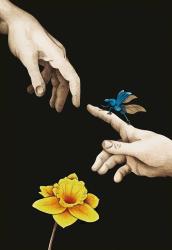
Because apparently it had not lasted. The bistro and the cheap wine proved it, and those eyes shining with a fever that was not of the body. Nonetheless he had lived some months savoring each moment of the daily mediocrity of his life, the breakup of his marriage, the ruin of his fifty years, sure of his inalienable mortality. One afternoon, crossing the Luxembourg gardens, he saw a flower.
“It was on the side of a bed, just a plain yellow flower. I’d stopped to light a cigarette and I was distracted, looking at it. It was a little as though the flower were looking at me too, you know, those communications, once in a while … You know what I’m talking about, everyone feels that, what they call beauty. It was just that, the flower was beautiful, it was a very lovely flower. And I was damned, one day I was going to die and forever. The flower was handsome, there would always be flowers for men in the future. All at once I understood nothing, I mean nothingness, nothing, I’d thought it was peace, it was the end of the chain. I was going to die, Luc was already dead, there would never again be a flower for anyone like us, there would never be anything, there’d be absolutely nothing, and that’s what nothing was, that there would never again be a flower. The lit match burned my fingers, it smarted. At the next square I jumped on a bus going, it wasn’t important where, anywhere, I didn’t know, and foolishly enough I started looking around, looking at everything, everyone you could see in the street, everyone on the bus. When we came to the end of the line I got off and got onto another bus going out to the suburbs. All afternoon, until night fell, I got off and on buses, thinking of the flower and of Luc, looking among the passengers for someone who resembled Luc, someone who looked like me or Luc, someone who could be me again, someone I could look at knowing it was myself, that it was me, and then let him go on, to get off without saying anything, protecting him almost so that he would go on and live out his poor stupid life, his imbecilic, abortive life until another imbecilic abortive life, until another imbecilic abortive life, until another …”
I paid the bill.
|