 |

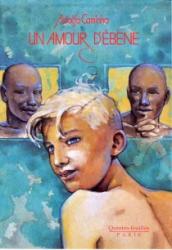
This novel by the Brazilian writer Adolfo Caminha was first published in 1895. An English translation by E.A. Lacey was published in 1982 by Gay Sunshine Press.
The novel was the first major literary work on homosexuality to be published in Brazil, and one of the first to have a black person as its hero. The novel caused a stir upon its publication but was almost forgotten in the first half of the 20th century. In the second half of the 20th century, the novel has been republished several times in Brazil and translated into English, Spanish, German and French.
Amaro avoids slavery by joining the navy, where he becomes known as Bom-Crioulo for his strength and good character. He befriends a young cabin-boy, Aleixo, and their friendship develops into a homosexual affair. When their ship returns to Rio de Janeiro, Bom-Crioulo rents a small room from Dona Carolina where the two live together. But when Bom-Crioulo has to return to sea separately from Aleixo, Dona Carolina seduces him, and the two become lovers until Bom-Crioulo, hospitalized after his return from the sea, discovers the affair.
Quote: The translation of this grim and profoundly subversive novel from a long-forgotten past and a distant country has been a useful historical and intellectual exercise for the translator, and I hope a perusal of the text may be equally useful to the reader. A book like Bom-Crioulo truly deserves to be better known in the arena of world literature, both for the fortuitous fact of its being the world's first modern gay novel and for the sad, shocking verities about the human condition presented in its lucid, imperturbable, almost complacent expose of life in the Brazilian navy and in the bas-fonds of the city of Rio de Janeiro some one hundred years ago. Though the novel is short, and relatively simple in both plot and language, it did produce certain problems in translation that are worth a brief mention.
To begin with, the nautical vocabulary employed in the descriptions of life on the corvette and of harbour and naval activities in the port of Rio de Janeiro is both technical and quite archaic. I have tried to familiarize myself as much as possible with the construction and operation of nineteenth-century ships, but inevitably the modern English equivalents found will on occasion lack precision. I trust readers more versed in the subject will charitably forgive my lack of expertise and make their own corrections.
As Mr. Sa Barbosa has noted in his Introduction, Brazilian Naturalism is both Romantic and Naturalistic at the same time, and Caminha was definitely a Romantic Naturalist. As such, he shares certain characteristics with both schools. One of his Romantic inheritances, for example, is a distinct fondness for "set pieces" of description or narration. These, while they are sometimes masterpieces of vigour, economy and significant detail — for example, the unforgettable scene of the canings in Chapter I, or the description of the sailors singing and playing the guitar, and later sleeping, in Chapter III — on other occasions do not particularly advance the action of the novel (for example, the long digression on the past of Miz Carolina, in Chapter IV). Often they seem to have been inserted in obedience to some caprice of the author (like the carillon playing Les cloches de Cornevilleconventional and only of limited interest, such as the description of the storm, in Chapter III, or the many descriptions, passim, of harbour activities and of the general landscape of Rio de Janeiro. There was a strong temptation to excise such passages, but in view of the novel's historical interest they were retained. However, a description such as "above, in the dome of the great half-sphere of the sky, ablaze with noonday light, the blue, always the clear blue, the pure blue, the sweet, transparent, infinite, mysterious blue", even with its reminiscence of Machado de Assis, cannot be considered one of the great passages of Romantic literature — and there are too many such in Bom-Crioulo.
One of Caminha's pronouncedly Naturalistic characteristics, on the other hand, inherited from writers like Zola and Eca de Queiros (and shared with authors like Hardy and Conrad, whom Caminha, for chronological and cultural reasons, cannot have read, though the affinity with Conrad is striking, both in vocabulary and style, and in the choice of subject matter), is the excessive use of a rather dry, technical, scientific, often anatomo-medical vocabulary, especially in dealing with human physiological and psychic phenomena, which seems incredibly unRomantic and unfeeling to the modern reader. Words like prognathism, hermaphroditism, dyspneia, ecchymosis, strabismus, callipygian and other less objectionable terms, such as pathological, magnetic, galvanic and genetic, litter the text. Such terminology, for the Naturalistic author, served both for exactitude and as euphemism, as, for example, when masturbation is called "an ugly and depressing but very human act" or "excesses which doctors condemn", anal intercourse becomes "the act against nature", and semen is "prolific gum" or "the generative juice of man".
Yet an attempt was made to respect Caminha's euphemisms, which may seem ridiculous and unnecessary today, but which, like "limbs" for "legs", reflect the man, the style and the period. With direct reference to Bom-Crioulo's homosexuality (and I do not wish to be drawn into a discussion of whether Caminha was or was not gay — there is evidence in both directions, and it is conflicting — except to note that a career in the navy is certainly among the most likely to have familiarised him with homosexual activity, and growing up and living in a traditionally sexually relaxed country such as Brazil would tend to have made him tolerant of it: what is important to note, however, is that he was a Naturalist — or polymorphously perverse, as we might say today — to whom by definition any and all human phenomena were "natural" and "right"), the author four times uses the term "pederasta" (always more acceptable in Portuguese, under the influence of French "pede", than in English), once "uranista" and various times euphemisms, such as "Greek love", "Greek carnality", "Priapus", etc. It was felt that "pederast" was too derogatory in English to be used, and "uranist" too dated, so substitutes had to be found. Since "homosexual" was not a very common word at that time, I tried to restrict its use as much as possible. Similarly, Miz Carolina's sexual inclinations, which might at a later date have been labelled bisexual or lesbian (she liked feminine-looking boys) have been called here by the name given them in the text — "hermaphroditic tendencies".
With regard to obscenities and profanities, the only ones which Bom-Crioulo employs in speech, besides the mild "que diabo!" ("what the devil! what the hell!") are, once only, "merda" ("shit"), and, quite frequently, the popular expression, "puta que o(s) pariu" ("son-of-a-bitch, sons of bitches"), which Caminha always chastely abbreviates, omitting the offensive word "puta" ("whore"). This is not necessarily a sign of Caminha's hypocrisy or caution. The Portuguese language, in both its Brazilian and its Portuguese variant, is, in keeping with the mild, tolerant character of Brazilians and Portuguese, considerably less obscene, profane and scatological than English or, for example, Spanish. Few indeed are the popular expressions of this nature used in daily speech to express annoyance or anger.
With regard to more generalised use of slang terms, there was no attempt to render this translation in strict nineteenth-century style, but a general appropriateness of vocabulary was sought. Thus, Bom-Crioulo is allowed to call the cabin-boy "kid" in speech, but in the descriptive and narrative passages he is always referred to as "boy" or "lad". Similarly, the offensive term "nigger" was used when, in direct speech, there was obviously the desire to insult or give offense, but Portuguese "negro" and "crioulo" are always translated "black (man)" or "Negro" in other contexts. Finally, it may be remarked that Caminha shares the generally mechanistic, determinist, decidedly pessimistic bias of the other Naturalists of his school and time (despite positivist currents that dominated socio-political thinking in Brazil in that era). This is perhaps as much due to the unhappy circumstances of his life and to his familiarity with Brazilian reality, then as now, as to any literary or philosophical doctrine. At all events, to him human beings are evidently mere animals — animal metaphors so abound in the text as hardly to need a commentary — driven by forces and appetites beyond their control, doomed in most cases to a tragic or inglorious fate, and with only fleeting gleams of the angel or the immortal in them. In his fictional world, therefore, impulses and desires are always "irresistible", attractions are "magnetic" and/or "fatal", antipathies are "instinctive", the male is a "slave" of the female (and vice versa) and is "inexorably" drawn to her (or to a male substitute), the greatest pleasure of the human being is to see, to be a spectator of others' misfortune (as though the strongest human emotion were curiosity), and human behaviour is limited, in its freedom, to a kind of animal choice among inevitable, generally unpleasant or degrading alternatives. Despite this tiresome reiteration of adjectives and concepts, there is little the translator can do to vary or palliate such a vocabulary. It bespeaks a world-view which is one of the factors that make the works of the great Naturalist authors (and Caminha, on the basis of two of his published novels, deserves to rank not unfavourably among them) so disturbing and so depressing, even now, a century after their writings began to appear. I might quote here the warning of the Brazilian critic Valdemar Cavalcanti: "Accordingly, I advise no one to read this novel. I find it too corrosive, not so much because of its theme and contents but above all, because of the degree of pessimism it contains. It is a sombre book, with sombre characters, a sombre life!" But Caminha's pessimism, it should be remembered, is no blacker than that of Hardy, Zola, Eça de Queirós, or the master of the Brazilians, Machado de Assis, who wrote, at the end of Memórias Póstumas de Brás Cubas (Epitaph of a Small Winner) that he had done one good thing in life, had one credit to his account, that he had not "transmitted the misery of this existence to any other human being"; and, at the end of Dom Casmurro, that fate had so willed that "my dearest friend and the woman I loved best in life — both so loving, both so beloved — should join together to betray me" — a sort of heterosexual mirror image of the theme of Bom-Crioulo.
Bom-Crioulo was — and remains — a truly revolutionary work: revolutionary in its denunciation of slavery, sadism, cruelty and man's exploitation of man; revolutionary in its revelation of society's complicity, its conspiracy of silence regarding all these abuses; revolutionary in its startling attitudes toward homosexuality, toward race, toward interracial and inter-age contacts. In the eighty-six years that have intervened since its publication (in a country whose traditional liberalism permitted such things to be published, even in those puritanical times — let due credit be given to the not-often-recognised "permissiveness" of that inchoate but great country, Brazil), it has lost little of its impact. Like Mary Shelley's Frankenstein and Goethe's Die Wahlverwandtschaften (Elective Affinities), it is one of the supremely idiosyncratic works of nineteenth-century fiction. Nevertheless, it belongs firmly to its times, and to their literary current — Naturalism. The world of the Naturalists is a sombre one, a world of closed doors and no exits, a world that allows no second chances, the natural predecessor of our doomed modern world. For this reason, if for no other, the story of the black slave who dared to dream of love, freedom and a world beyond race, sex and age, and learned too late that society would grant him none of these, only betrayal, imprisonment and discrimination, should be read and remembered. I could say, with Ford Madox Ford, "this is the saddest story I have ever heard." Its message echoes beyond our time.
|