Welcome Guest, Not a member yet? Create Account  


Forum Statistics

14 Members,   3,536 Topics,   10,207 Replies,   Latest Member is Stanley


  Desert Boys (2016)
Posted by: WMASG - 12-15-2025, 05:45 PM - Replies (1)


This series of powerful, intertwining stories illuminates Daley Kushner's world - the family, friends and community that have both formed and constrained him, and his new life in San Francisco. Back home, the desert preys on those who cannot conform: an alfalfa farmer on the outskirts of town; two young girls whose curiosity leads to danger; a black politician who once served as his school's confederate mascot; Daley's mother, an immigrant from Armenia; and Daley himself, introspective and queer. Meanwhile, in another desert on the other side of the world, war threatens to fracture Daley's most meaningful - and most fraught - connection to home, his friendship with Robert Karinger.

A luminous debut, Desert Boys by Chris McCormick traces the development of towns into cities, of boys into men, and the haunting effects produced when the two transformations overlap. Both a bildungsroman and a portrait of a changing place, the book mines the terrain between the desire to escape and the hunger to belong.

Continue reading..

  drawings from the diaries (2000)
Posted by: WMASG - 12-15-2025, 05:40 PM - Replies (1)


Born in Sydney, precociously talented both as an artist and a writer, Donald Friend grew up in the artistic circle of his bohemian mother. He studied with Sydney Long (1931) and Dattilo Rubbo (1934–1935), and later in London (1936–1937) at the Westminster School of Art with Mark Gertler and Bernard Meninsky. During World War II he served as a gunner with the AIF, and while stationed at Albury began an important friendship with (fellow Australian artist) Russell Drysdale which was to culminate in their joint discovery of Hill End, a quasi-abandoned gold mining village near Bathurst, New South Wales, which was to become something of an artists' colony in the 1950s. He also served as an official war artist in Labuan and Balikpapan in 1945. After the war he lived for a time in the Sydney mansion-boarding house Merioola, exhibiting with the so-called Merioola Group.

Much of Friend's life and career were spent outside Australia, in places as diverse as Nigeria (late 1930s, where he served as financial advisor to the Ogoga of Ikerre), Italy (several visits in the 1950s), Sri Lanka (late 1950s – early 1960s), and Bali from 1968 until his final return to Sydney in 1980.

Friend wrote over 2 million words in diaries he kept from when he was a teenager, until the year he died. The 4 volumes of Friend's diaries, published by the National Library of Australia, runs to over 2800 pages. Scattered throughout, and integral to the diaries are sketches made by Friend.

Quote:A beautifully printed publication that, for the first time, brings to the public a representative selection of the extraordinary drawings from the Donald Friend diaries held in the National Library of Australia. Witty, moving and evocative, these drawings chronicle the brilliance of one of Australia's finest draughtsmen over four decades. The volume is an essential purchase for all lovers of Australian art and culture.

As an artist, Donald Friend is rightly celebrated most of all for his gifts as a draughtsman, that most subtle and classical of forms, at its best the most breathtaking and the most humane of the visual arts. His fellow artists, understanding the inheritance, were generous in their praise. Drysdale admired Donald Friend’s ‘ability to delineate a series of forms in an almost calligraphic line’. John Olsen saw him as a remarkably vital technician and placed him in the forefront of Australian draughtsmanship. He observed that Friend was ‘at the height of delight when wading in coloured puddles of ink, slashing a line with the rasp of a fork-like pen’. Art historians too have readily acknowledged the achievement. Andrew Sayers, in his survey history of drawing in Australia, has agreed that it was the ability to control line and through it to express form that deservedly won Donald Friend his many admirers. Those qualities—which Lou Klepac invests with a new depth and meaning in his latest book, The Genius of Donald Friend—give Friend his claim to an honoured place in the art history of his country. Robert Hughes saw Donald Friend and Godrey Miller as the two finest draughtsmen of the nude in the history of Australian art.

Continue reading..

  The Cosmic Turtle (1976)
Posted by: WMASG - 12-15-2025, 05:35 PM - Replies (1)


It would be best, it would make matters simpler, if the writer were to be identified as an old monkey. A monkey sprung from the tribe at Sangeh in the interior. This monkey is clever but not wise. Mischievous without malignancy. If others feel superior to him, he does not know it, since he is dictatorial, paternalistic and egoistic: yet not indifferent to the greater good of all. Aggressive or defensive as occasions demand. Desirous of respect, contemptuous of familiarity. Instinctively, territorially conservative in an age when nosy-parkers and stickybeaks abound. Ah, tolerance, tolerance! — the intruders are necessary to his health. They help define the limits of his universe. At sight of them invading he rushes gibbering to the boundaries, his glands healthily secreting great gushes of adrenalin.
His joyful triumph is a marvel to witness when invaders scamper back to their own overcrowded warrens, giggling as they go. The defended territory is no great matter: some glades of trees, some lawns and gardens overflowing flowers to the lagoon’s edge. A line of foam flashes on the reef: the end of Asia. From that verge one slip, one false step, will (splash) thrust you struggling for survival into the waters of the true antipodes, caught in a current that races with the speed of bolting sea-horses from here to the crocodile-infested mangrove swamps of Carpentaria.
One night in dry season, to the terrace by the sea-wall over-looking the dreaming lagoon, came a visitor. My friend Leonard. Or should he be styled my semi-tragic friend Leonard, the victim of a brilliant intellect infatuated by logic? — or introduced as my illogically inspired French-Russian-Jewish-English-Swiss friend, the native of Padua?
No matter. I like him, despite his being strenously a man of excess. Of excessive everything — excessive desire, despair. Excessive virtues and vices, indulging excesses of intelligence, talent, poverty, extravagance. ,
His remarkably finely modelled features have the pallor of alabaster; a setting for dark eyes and black brows, framed by close curling black hair neatly topiaried to the silhouette of a Byzantine apostle.
His garments also dispose themselves in apostolic folds — loose folds of light cotton that hint at Thebaid solitudes, ashrams near the snowline where the winds sing and set the prayer-wheels spinning.
But not to prayers do his talents lead him. Instead, to electronics, and through the technology of sound to multi-lingual translations for International Conferences and a United Nations

Continue reading..

  The Naked Club (2015)
Posted by: WMASG - 12-15-2025, 04:57 PM - Replies (1)


The Naked Club is a young adult coming-of-age novel written by Russell James.  When Drew was six, something momentous and strange happened.  He was playing in a fountain in the park on a hot summer day, and he and Ryder, his 4-year-old cousin, were racing through the jets of water and relishing the cold water as it hit their naked bodies.  Suddenly, there was another boy in the water with them.  He was wearing a Bugs Bunny swimsuit and seemed older than Drew.  They greeted each other, and Drew began to feel undressed, but the stranger pulled off his swimsuit instead.  Their chasing, splashing and joyful play were short-lived, however, as the moment was abruptly shattered by the strained looks on the faces of Drew's mother and Aunt Dee, Ryder's mom.  There was a policeman with them, who ordered the boys to get dressed.  Aunt Dee protested that nudity was a natural state for such young children, but her defiance only resulted in a citation.  The stranger seemed to be having his own problems with his parents who were reprimanding him and hastily redressing him in his bathing suit.  The mood may have been broken, but the memory remained strong in both Drew's and the stranger's minds.

Russell James' young adult coming-of-age novel, The Naked Club, is lyrical and compelling.  While the bulk of the action takes place six years later, when Drew is 12 and Ryder is 10, the mood of this work is beautifully set by the momentary flash of freedom that they experienced in the fountain as small children.  The reader instantly becomes aware of the closeness of the two boys which is mirrored by the amicable relationship of their moms.  Aunt Dee and Ryder's presence in the house with Drew and his mother is harmonious and seems so beneficial for them all.  I loved feeling privy to the discovery of the tree house along with Drew and Ryder, seeing as their imaginations take over and watching as the long-deserted structure gives them a sense of autonomy and identity.  The Naked Club is often moving and, at other times, hilariously funny, and it captures so well the turbulence and wonder of coming of age.  It's most highly recommended.

Continue reading..

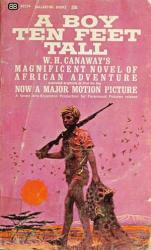
  A Boy Ten Feet Tall (1961)
Posted by: WMASG - 12-15-2025, 04:51 PM - Replies (1)


Originally printed in England under the title "Sammy Going South", later printed by The Viking Press as "Find the Boy". The introduction note says: "'A Boy Ten Feet Tall' is the African 'Huckleberry Finn', with the Nile substituted for the Mississippi... Each adventure along the way educates the boy, tests him, and is the novelist's short-hand way of describing him growing up."

Quote:Sammy’s father and mother seemed to have been arguing for days. His father no longer went every morning to teach English at the new lycée, but stayed at home in dressing gown and slippers, smoking a great deal, listening to news bulletins on the radio, and arguing, arguing with Sammy’s mother.
They argued about something called the Crisis. Sammy didn’t know the meaning of the word, but it dawned on him all the same, with a sense of horror, that his mother was trying to persuade his father to leave Port Said. Leave Port Said? Leave the wonderful Canal, with the big liners gliding gracefully along, and all the people waving to him; leave his friends, Mahmoud the doorkeeper’s son, Busty who kept the sweets and lemonade stall by the ferry to Port Fuad? Unthinkable, terrible! He burst into tears.
His father said, “Now look what’s happened. The kid’s crying,” and comforted him. His mother said nothing but set her lips and sat straight and beautiful in the cane chair and looked out through the windows of the flat. Sammy saw that she was crying too and went over to her, slipping from beneath his father’s arm.
She caressed his head absently, her other hand holding the letter which had come that morning from Sammy’s Aunt Jane in Durban.
“Tony,” she said, “Jane says that if we won’t go, she’ll have Sammy till things settle down. I must admit she doesn’t seem terribly keen, but it would be no trouble for her. After all, she keeps a hotel. Sammy could fly down. We could scrape up the fare somehow.”
For Sammy this put a different complexion on things. He knew his Aunt Jane kept the Duiker Hotel in Durban, and when his mother asked him if he would like to go in an airplane for a short holiday with his aunt, he began to bounce excitedly up and down, shouting, “Yes-yes-yes! I want to fly in a plane!”
His father said, “Stop behaving like a baby. Anyone would think you were five, not ten. You’re not going, and that’s that.”
When that started another argument, Sammy made himself scarce. He wandered disconsolately out of the flat. Grown-ups muck you about, he thought. For heaven’s sake why can’t I go in a plane? By the time he had descended the three flights of stairs, he was a plane. He pulled out of a steep dive into the courtyard, flattened off, and buzzed in a tight turn through the fat and stubby palms. The afternoon was pleasantly warm, and the doorman-cum-gardener was nodding, perched on an old box with his back against the dusty white wall splotched with scarlet hanging flowers. Sammy landed and switched off.
“Saida, ya Bouab,” Sammy began diffidently in the Arabic which he spoke almost as well as his own language; and the doorkeeper opened a yellow eye and grinned, for he liked Sammy.
“Where’s Mahmoud?” asked the boy, and the man lifted a hand in despair and resignation.
“How should a father know where his son is these days? Dodging his work, I have no doubt.”

Continue reading..

Online Users
There is currently 1 user online 0 Member(s) | 1 Guest(s)

Welcome, Guest
You have to register before you can post on our site.

Username
  

Password


Search Forums

(Advanced Search)