
Welcome Guest, Not a member yet? Create Account  


Forum Statistics

14 Members,   3,536 Topics,   10,207 Replies,   Latest Member is Stanley


  The Whispers (2019)
Posted by: Simon - 12-11-2025, 02:42 PM - Replies (1)


Before she disappeared, Riley's mama used to tell him stories about the Whispers, mysterious creatures with the power to grant wishes.

Riley wishes for lots of things. He wishes his secret crush Dylan liked him back. He wishes the bumbling detective would stop asking awkward questions. But most of all he wishes his mother would come home . . .

Four months later, the police are no closer to finding out the truth - and Riley decides to take matters into his own hands.

But do the Whispers really exist?

And what is Riley willing to do to find out?

Quote:I push my hair out of my eyes and look up at the clock on the wall. It shouldn’t be too much longer. Maybe I can just wait him out. I look at the desk in the corner of the cramped office. It’s cluttered with books, stacks of file folders, and a darkened computer screen decorated with a rainbow of Post-it notes because Fat Bald Detective can’t remember anything. There isn’t one inch of clear space anywhere to be seen on his desk. It’s very unprofessional.
That was one of our words from the calendar—I think from last January. It’s still on my wall.
Unprofessional is when someone or something doesn’t look or act right in the workplace.
Good, Button. Now use it in a sentence, Mama would say if she were here.
Then I would say something like, Fat Bald Detective’s office is very unprofessional because there’s crap everywhere and it smells like Fritos.
That would have made Mama laugh. I could always make her laugh when we played the word-of-the-day game. Mama says it’s okay if you don’t always remember the exact dictionary definition of a word as long as you can describe the meaning in your own words and you can use it in a sentence. Now that I think of it, there should be a picture of Fat Bald Detective’s office beside the word unprofessional in the dictionary.
His office is nothing like the ones in the police stations on TV. There aren’t any bright fluorescent lights in here, or cool floor-to-ceiling walls of glass so he can see the whole department and wave someone in at a moment’s notice just to yell at them. There’s only one small window with a view of the parking lot, and Fat Bald Detective seems to prefer table lamps to fluorescent lighting. And although you can’t smell the offices of the police stations on TV, I always imagined they’d smell like leftover pizza and cigarette smoke—not Fritos. I guess it’s better than doing this in one of their interrogation rooms. At least in here there’s a couch for me to sit on before they lock me up and throw away the keys. Then it hits me. It’s the couch. The couch smells like Fritos.
“And what happened after that, Riley?” Fat Bald Detective says—again.
Fat Bald Detective has a name. It’s Frank. He said I could call him Frank the first time he brought me in for questioning. Mama doesn’t normally approve of us calling adults by their first name, but Frank told me to and he’s the law. I figure I should probably cooperate as much as possible so he doesn’t get any more suspicious than he already is.
Frank actually has three names. They’re all printed on his door and on the triangle nameplate on his desk. Grandma says that people who use three names are puttin’ on airs, but I don’t think Frank has any airs to put on. He’s short, and bald, and round, and looks like Mr. Potato Head without the tiny black hat, so I think Fat Bald Detective every time I look at him.
“I don’t remember,” I say.
He keeps asking me what happened that day and I keep telling him I don’t remember. We’ve played this little game for almost four months now. I was ten when we started. I’m a whole different age now. I’ve had a birthday and a summer break since then. I even moved up a grade in school. Detective Chase Cooper on Criminal Investigative Division: Chicago can solve a case in an hour.

Continue reading..

  The Boy in the Woods
Posted by: Simon - 12-11-2025, 02:38 PM - Replies (1)


Maxwell Smart was eleven years old when his entire family was killed before his eyes. He might have died along with them, but his mother selflessly ordered him to save himself. Alone in the forest, he dug a hole in the ground for shelter and foraged for food in farmers' fields. His clothes in rags and close to starvation, he repeatedly escaped death at the hands of Nazis.


After months alone, Maxwell encountered a boy wandering in the forest looking for food. Janek was also alone; like Maxwell he had just become an orphan, and the two quickly became friends. They built a bunker in the ground to survive through the winter. One day, after a massacre took place nearby, the boys discovered a baby girl, still alive, lying in the arms of her dead mother. Maxwell and Janek rescued the baby, but this act came at a great cost.

Max's epic tale of heroism will inspire with its proof of the enduring human spirit. From the brutality of war emerges a man who would become a celebrated artist, offering the world, in contrast to the horrors of his suffering, beautiful works of art. The Boy in the Woods is a remarkable historical document about a time that should never be forgotten. 

Quote: “It was a sport to kill a Jew,” he says. “[Your typical Nazi] is not going to go in the mud and get dirty and filthy; he is doing it for happiness, for enjoyment. So when it was raining, I knew I was safe.”

Smart is a Holocaust survivor. He was just nine when the Nazis took away his parents and younger sister, leaving him completely alone. He lost more than 60 members of his family in that time. But he did not talk to a single person about it for 70 years. “The Holocaust did not exist,” he says. “It was taboo in my house. My children didn’t know anything.

“After the war I could not allow myself to think about the torture of my past. I wiped it out,” he says. He changed his name – from Oziac Fromm to Maxwell Smart – and never looked back. The only hint at the atrocities he witnessed lay in the vivid, expressionist works he painted as an artist: the fir boughs he used to build shelter in the forest, the trees he would look up at while he was daydreaming.

Smart was born in 1930 to a Czech mother and Polish father. When he was a young child, the family moved from Czechoslovakia (as it then was) to Buczacz, a small city which was then part of Poland (now Buchach, it is part of Ukraine).

He remembers flashes of his prewar childhood: family dinners before shabbat; dressing up for synagogue; his uncle – a cartoonist for a newspaper – taking an interest in his art after Smart was praised for it at school. He and his younger sister Zonia were well looked after. His father ran a clothing store and “looked like an English gentleman – he never went out of the house without a fedora hat!”. About half of the 8,000 people who lived in Buczacz were Jewish.

After the second world war broke out, Buczacz came under Soviet occupation. The economy tanked and his father’s shop went out of business. Then, in July 1941, the Nazis seized Buczacz. A contact of Smart’s father offered the family safe passage into the Soviet Union – but his mother wanted to stay. They had a life in Buczacz and news of the camps had not made it there. “Nobody knew about the horrors the Germans created,” says Smart. 

Under Nazi occupation, militias patrolled the streets, attacking Jewish people and businesses, destroying Smart’s synagogue. The Nazis were joined by the Ukrainians – who saw them as liberators. Smart often played with the neighbouring children, who were Ukrainian. One day, his mother went to see if they would be interested in buying some of the Smarts’ possessions in exchange for food. “The neighbour says to her: ‘You have no right to sell anything – anything that is Jewish belongs to the government.’”

One day a notice was given for all Jewish men aged 18-50 to register for labour. Smart’s father was ordered to the town square along with 350 others. His father told him he’d be right back. On the square, the men were separated into two groups: one for professional workers (doctors, lawyers, teachers); one for skilled tradesmen. The professionals, including Smart’s father, were taken to a nearby hill and shot. Smart did not find this out until many years later.

The families were told that their men would be released if they relinquished their assets. “I remember my mother went to borrow money to pay them off,” he says. “It was all just a story. They were already dead. They collected the money but I never saw my father again.”

Buczacz’s Jewish community was moved into a ghetto and forced into labour. On one trip home from shovelling wheat, Smart and dozens of others were taken away in trucks by armed guards. They were stripped and imprisoned for three days. “I remember being in jail without food, without water. I was creative: I took off my shoe, I pushed it out through the window to catch snow in the shoe to have some water. Everybody shared it.”

Continue reading..

  Ephebophilia, Hebephilia & Paedophilia (2017)
Posted by: Simon - 12-11-2025, 02:33 PM - Replies (1)


The result of twenty years of research, Will H.L. Ogricn's monumental work belongs to what specialists in the documentary sciences call a bibliographic summation. Covering a particular field, it will, in contrast to general bibliographies, be qualified as special, which it is also in another sense of the word special: the subject treated is sometimes so delicate, in some respects, that it is the object of censorship, as evidenced by the suppression of cooperative encyclopaedias (wikis), in different languages, long present on the Web and devoted to paederasty 


It is unquestionably international, a qualification that it would have already deserved if it had been limited to the five most important European languages. In fact, the alphabetical list of languages taken into account in this book is impressive: Afrikaans; German; English; Bulgarian; Croatian; Danish; Chinese; Spanish; Esperanto; Finnish; French; Gaelic; Greek; Hebrew; Hungarian; Icelandic; Italian; Japanese; Latin; Dutch; Norwegian; Polish; Portuguese; Russian; Slovenian; Swedish; Czech; Turkish. There are also two or three dialects.

From a temporal point of view, it is both retrospective (the oldest reference dates from 1508) and current or contemporary since it extends up to the last year in which it appears: 2017.

Although the author aimed at exhaustiveness, he described it as selective, which is true insofar as he made a choice that is mainly due to the relative importance of the languages that had to be taken into account. Works with a very few results have not been discarded (the smallest mentioned is two copies) and some unpublished manuscripts are even referenced. Finally, this bibliography is partly analytical - since some references include a brief note (in English) - and descriptive because it provides details on the different editions of certain books.

As it stands, this bibliographical collection marks an important milestone not only in the field of "documentography" in general, but above all in the specialty announced in the title. Nothing of comparable importance had yet appeared, and it wll be a very long time before anything comparable will appear. 

Quote: Ogrinc was a son of miner Leonard Hubert Ogrinc and Johanna Catharina Crombach. In the year he was born, his brother Heini (1946-1951) was killed in an accident. He studied medieval history and was most recently a lecturer in that subject at the Rotterdam University of Applied Sciences. In 1976 he published an interview with Boudewijn Büch, of whom he had previously discussed the poetry collection Nogal droevige liedjes voor de kleine Gijs (Rather sad songs for little guys), a collection of poems about Büch's alleged love for young boys. Around 1978 he published Youthful Sinners in Constantinople by the journalist Esgo Taco Feenstra Kuiper (1857-1908), which, among other things, dealt with the available ephebes there. He made his debut as a poet in 1981 with Ger Kleis on his press Sub Signo Libelli with Secretum secretorum that also had the love for boys as its subject. However, his 'life's work' seems to have been the biography of Jacques d'Adelswärd-Fersen (1880-1923) of which he published a first version in 1994 in the Amsterdam, English-language magazine Paedika: The Journal of Paedophilia, and of which a fourth and final version appeared on the internet in 2014. This article was dedicated: 'In memoriam Heini J.A. Ogrinc (1946-1951)

Continue reading..

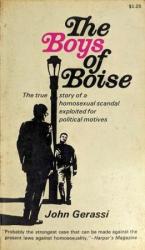
  The Boys of Boise (1966)
Posted by: Simon - 12-11-2025, 02:29 PM - Replies (1)


Written in 1965 about a same-sex sexual scandal that occurred in 1955 in Boise, Idaho (USA), John Gerassi's classic study depicts both middle America's traditional response to homosexuality and an era in the country's history before the modern gay rights movement really got underway. Because much of what Gerassi wrote about persists in today's struggles over gay and lesbian issues, his book still has much to tell us about how contemporary society reacts to, and misunderstands, homosexuality.” —Peter Boag On the morning of November 2, 1955, the people of Boise, Idaho, were stunned by a screaming headline in the Idaho Daily Statesman, THREE BOISE MEN ADMIT SEX CHARGES. Time magazine picked up the story, reporting that a “homosexual underworld” had long operated in Idaho's staid capital city. The Statesman led the hysteria that resulted in dozens of arrests—including some highly placed members of the community—and sentences ranging from probation to life imprisonment. 


Quote: Glancing through Time magazine one day in December 1955, I was suddenly struck by a story headed “Idaho Underworld." Immediately I wondered what kind of underworld could possibly exist in such a sparsely populated, basically poor state, where no city was big enough for an oiganized crime syndicate to operate either extensively or profitably. But the first paragraph set me straight. It explained that there is a kind of underworld I had not imagined, or rather it referred to an underworld that I, born and bred in a big city, would never have characterized as an underworld at all:

Boise, Idaho (pop. 50,000), the state capital, is usually thought of as a boisterous, rollicking he-man's town, and home of the rugged Westerner. In the downtown saloons of the city a faint echo of Boise’s ripsnorting frontier days can still be heard, but its quiet residential areas and 70 churches give the city an appearance of immaculate respectability. Recently, Boiseans were shocked to learn that their city had sheltered a widespread homosexual underworld that involved some of Boise’s most prominent men and had preyed on hundreds of teen-age boys for the past decade.

My first impulse was not to believe it—unless, of course, the local police and law-enforcement agencies were part of that underworld, and had been all along. For how else, I asked myself, could such an underworld flourish for so long? In a city of 50,000 people, surely the cops must be aware of everything that goes on. And unless the ringleaders were so highly placed in the state’s political machinery that they were untouchable, someone certainly would have exposed their operations long before.
Even if the cops, the politicians, the judges, the newsmen and the big businessmen were part of this underworld—a very unlikely possibility—would not a group of outraged parents have banded together to clean up the mess? After all, kids are kids, and no matter how pleasant or profitable their extracurricular activities may be, they are bound to talk, to brag, or at least to betray themselves accidentally. What’s more, not all of these “hundreds of teen-age boys” could possibly have grown up to be confirmed homosexuals. Surely some, reaching adulthood during “the past decade” and having kids of their own, would have made an attempt to put a stop to it.
The article went on to say:

In the course of their investigation, police talked with 125 youths who had been involved. All were between the ages of 13 and 20. Usually, the motive—and the lure—was money. Many of the boys wanted money for maintenance of their automobiles (Idaho grants daylight driving permits to children of 14, regular licenses to 15-year-olds). The usual fees given to the boys were $5 to $10 per assignation.

Clearly, therefore, not all the “125 youths” were homosexual. Many simply catered to the adult homosexuals for money. But would not their parents have been suspicious of their children’s sudden independent wealth? Obviously, there was more to the story than Time reported.
Perhaps, I thought, Boise had become as liberal as New York, where homosexuals are rarely arrested (except in shakedowns), where young men and even teen-age boys freely drag the streets in makeup and wigs. After all, I reasoned innocently, Idaho had produced one of the most radical senators of the union—Glen Taylor, who had been on the Progressive Party ticket with Henry Wallace in 1948. But no, Boise was a small town, and no such American town could ever become so liberal as to allow homosexuals to wander about freely picking up thirteen-year-olds—for a whole decade!
Sure enough, the last paragraph of that Time story read:

This week the shocked community and the state began a rehabilitation program for the boys. Social workers began to investigate each case, to work out family problems. A citizens’ committee representing virtually every organization in Boise began a campaign to get afterschool jobs for the boys, and a special team of psychiatrists will arrive this week from Denver, at the expense of the State Board of Health, to treat the young victims.

But now my suspicions were aroused from a different angle. Where could Boise get the finances to carry out such a program of rehabilitation? If the community was really shocked, why had nothing been done for ten years? And where would Idaho find so many qualified social workers to handle the job?
Three weeks later, Time printed a short follow-up story on the Boise underworld. In two quick paragraphs, it reported that more homosexuals had been arrested—and sentenced. But it also said:

Dr. John L. Butler, chief of Idaho’s Department of Mental Health, had publicly opposed sentencing the homosexual adults to prison terms: "We have to build up community supports for them," he said. "One alternative might be to let them form their own society and be left alone."

This statement raised all sorts of new questions. For one thing, how did Idaho ever get such a progressive-minded mental-health chief, one who dared to propose measures even New York would consider outrageous? Secondly, what happened to the kids? Did not Dr. Butler's suggestion that the homosexuals should simply live together imply that they were all consenting adults?
Nor did the sentences make much sense. The range seemed to be from six months to life—in prison. What kind of a judge would send a homosexual to prison for life—prison being a notorious breeding ground for homosexuality anyway? There were other unanswered questions: How were the youths rehabilitated? If hundreds were involved, what happened to the schools? And what, in fact, did the community do about it, besides creating a few after-school jobs?
Two years later, I became an editor at Time magazine, and one of my first acts was to look up the Boise file in the morgue. But there was nothing more on the matter. No one had seemed interested in following it up. I decided that someday I would.
My preoccupation with international politics kept me pretty busy for the next few years, however, and instead of going to Boise, I went all over South America and wrote a book on the revolutionary upheavals gripping that continent But I never forgot the Boise story, and in 1965, ten full years after the scandal broke, I finally took the time to check it out. I went to Boise.
Before doing so, I read everything I could find on homosexuality and on child molesters. I interviewed many psychiatrists and psychologists who specialized in the subject, including some who had worked on the Kinsey reports. I also did as much research on Idaho, its history, customs, politics and resources, as was possible from the outside.
Once in Boise, I rapidly discovered that it was going to be harder to find the answers than I had thought. First of all, some of the court records had disappeared, while others had to be traced down to individual law offices. Also, very few people were willing to cooperate. The memory of the scandal was still fresh, and often sore. Many city and state officials wanted the scandal kept buried, not only because it reflected adversely on their city and their state, but also for personal reasons: Their own behavior during the scandal had been far from irreproachable. Finally, many of the principals no longer lived in Boise.
Nevertheless, as I persisted, I did get some breaks. I met a group of young lawyers and newsmen who began to help me. Although my investigation was bound to hurt the Republican Party, which was in power in 1955 and still ruled Boise in 1965, these people came from both sides of the political fence. Indeed, I obtained some very useful information from members of the Radical Right, despite the fact that they were (and, I presume, still are) stanchly opposed to all mental-health laws.
Some of these young men had been teen-agers during the scandal, and a few remembered particular details that gradually helped me fit together the over-all puzzle: why the scandal broke, how it was exploited and by whom, and what happened to the town as a result. Eventually I was able to track down many of the principals who had left Boise and were now living in Seattle, San Francisco, Florida and elsewhere. Dr. Butler, for example, did turn out to be the progressive-minded psychiatrist that the Time article had implied, but he had understandably fared poorly in Boise and was no longer there. I found him, as dedicated as ever, in Portland, Oregon.
With each new piece of evidence, my questions became more precise. But with each such question, I apparently became more of a threat. I began to receive anonymous phone calls warning me to drop my investigation. One day I got another anonymous phone call, but this time it was a friendly one. “Your motel is going to get ransacked,” the voice said. “You’d better hide whatever material you’ve accumulated.” I immediately put all my documentation into a suitcase, drove out to the airport, and sent it to New York. When I returned to my motel, sure enough, someone had gotten in and turned every drawer inside out.
Finally I heard that the governor himself, Robert E. Smylie, had written a letter to Newsweek's man in charge of the northwestern territory. I had made it perfectly clear that though I was (then) a Newsweek editor I was in Boise on my own time for a story or a book that did not involve Newsweek, and so I had violated no rules of conduct. But the very fact that he had written such a letter, or that it was so reported to me, made me apprehensive. I asked a friendly lawyer to make sure that he heard from me or contacted me at least once a day.
I stuck it out until I had documented the whole affair. When I did, I realized that the Time article had been misleading in many ways. I also concluded that the whole scandal was one of the most shocking examples of legalized prejudice, involving politics and personal vendettas, that I had ever come across. Homes were shattered, families were broken and individual careers were ruined, sometimes with incredible viciousness. And the fabric of a whole town was laid bare, revealing to what extent it rested on pettiness, intolerance and the personal ambition of a few.
I also understood, perhaps for the first time, what life in a small town is really like, and since America is ultimately made up of such small towns, I understood what America is really like. Because Boise is one of those typical American communities that has a single daily newspaper, I realized that the freedom of the press we cherish so much can be just as much of a farce in America as it is in countries where the press is controlled by the government. For what is the difference between a newspaper that prints only what the government tells it to and a newspaper that prints only what an all-powerful editor, catering to the establishment of the community, decides is news or fact?
Many of the men convicted for “infamous crimes against nature” in Boise in 1955 and 1956 should have been separated in some way from society: They were indeed child molesters. But the way the cases were handled not only illustrates the moral corruption of a small city wrought by its own stifling conformity and fears, it also exposes the quicksand on which so much of our American society is erected.

Continue reading..

  The Monkey Cages (2018)
Posted by: Simon - 12-11-2025, 02:26 PM - Replies (1)


In the summer of 1955, sixteen-year-old Tommy Cadigan finds himself helpless in the face of desire, especially when the man that wears the face is his high school swimming coach, a young Korean War veteran who is still recovering from receiving a "blue ticket" discharging him from the military because of his homosexuality. Unsure if his infatuation is returned, Tommy distracts himself with the attention of a local bully, who hustles older men at night besides a decrepit zoo in Boise's park. Tommy soon finds himself in the midst of a scandal that threatens to ignite the entire town...and his life will never be the same.

Review
And here it is: "Fast-paced, sexy, and intriguing. Casey Charles ushers us to front row seats for his startling, gossipy imagining of the Boise homosexuality scandal of 1955. How do these things happen? Find out from some characters who would know."
- David Pratt, Lambda Literary Award-Winning author of Bob the Book

"The Monkey Cages is a coat of many colors, part coming of age story, part romance, part courtroom drama, with all of them adding up to be a sexy, searing consideration of just what it takes to live life with candor and pride. And not since The Front Runner has there been such a coach."
- Vinton Rafe McCabe, author of Death in Venice, California

Continue reading..

Online Users
There are currently 2 online users. 0 Member(s) | 2 Guest(s)

Welcome, Guest
You have to register before you can post on our site.

Username
  

Password


Search Forums

(Advanced Search)