Welcome Guest, Not a member yet? Create Account  


Forum Statistics

14 Members,   3,536 Topics,   10,207 Replies,   Latest Member is Stanley


  Burgess, Anthony - A Dead Man in Deptford (1993)
Posted by: Simon - 11-22-2025, 02:30 PM - Replies (1)


Serendipity was in action when I decided to move onto this after Death of the Fox. Although Christopher Marlowe is the protagonist here, and events take place some thirty years earlier than Garrett’s story, A Dead Man in Deptford also features Raleigh as a prominent character (though morally more ambivalent). Both books are written in a dense, elaborate, semi-archaic style and both create a vivid impression of late Elizabethan England, although these impressions couldn’t be more different from each other.

While Death of the Fox has the air of a great pageant, A Dead Man in Deptford plunges you into a world where the language is studded with cant and cod-Latin, a rich, irreverent, bawdy, brilliant stew of a novel. If you don’t know what to expect then don’t be discouraged. A bewildering confection of words and references rapidly resolves itself into a very good story and, because this is a short book, the plot absolutely barrels along. It’s always great to read a novel which the author enjoyed writing, and Burgess clearly had a good time (he occasionally seems to be enjoying himself to almost indecent extremes).

The story opens with the young Kit Marlowe studying theology at Cambridge, by duty rather than choice. Bored by his studies and indifferent to the prospect of a life as a humble clergyman, Kit amuses himself by writing verses, undermining the devout convictions of his fellow students and indulging in the odd spot of fervent buggery out at Grantchester. By chance he meets Tom Watson, an agent of Francis Walsingham, who sees potential in this impious young man and urges him to come to London, to meet Sir Francis and to see what he can do for his country.

And so, Kit is soon signed up to ‘the Service’ and travels to France, in an effort to unearth information about the intentions of exiled English Catholics and to find intelligence about plots against the Queen. Along the way he becomes infatuated with Sir Francis’s handsome young cousin, Thomas Walsingham; and Kit’s first mission to the Continent has all the flavour of a debauched student jolly. At first it all seems like a game – and it is, really: a very dangerous game in which lives are at stake. The trouble begins when Kit comes to realise that the Service is not something which he can put on and take off as he pleases, to suit his studies and his dreams of writing for the stage. Like superstition and religion, it is merely another form of prison; and there is no way out, save one.


Continue reading..

  Adams-Ockrassa, Warren - The Beasts of Delphos (2013)
Posted by: Simon - 11-22-2025, 02:22 PM - Replies (1)


Delphos is a place of unique beauty, wealth and rarity, famed throughout the human-settled worlds of the Twenty for its magnificent jungle landscapes, exotic foods, precious minerals, and its inhabitants' skills at sensual delights. Native Delphans such as Barris hardly find this remarkable.

But there are beasts on Delphos.

And as Barris continues his labors at the mine he has known almost from birth, he discovers that some beasts can wear human skin.

For Delphos is a slave world, and Barris has never drawn a free breath in his life.

This is the first of three volumes in the Delphos Cycle, a series of far-future SF titles that feature Delphan characters and the history of Delphos, one of the worlds of The Twenty.
Delphos is a planet where young boys please older boys as a natural state of being.


Please note that this story includes themes of sexual discovery and coming of age in young men. Mature audiences are recommended.

This book uses an embedded typeface, Delphic Serif, to display text in the chapter titled "Words". The embedded typeface may not display correctly on some devices, notably the iPad and iPhone, due to limitations in the host operating system. While inconvenient, this does not affect the narrative in a meaningful way.


Continue reading..

  Adams, HC - Schoolboy Honour (1861)
Posted by: Simon - 11-22-2025, 02:17 PM - Replies (1)


Henry Cadwallader Adams (1817-1899) was a British clergyman, educator and children's author, best known for his many contributions to the boys' school story genre. Born into a notable Warwickshire family, he was educated at Westminster School, Winchester College, Balliol College (1835) and Magdalen College, Oxford (1836), becoming a fellow of Magdalen in 1843. After some time as a school-master at Winchester, in 1855 he became the chaplain of Bromley College, an almshouse for the widows of clergy. In 1852 he married Esther Edmonds, and went on to become the vicar of Dry Sandford and later Old Shoreham (1878-1896).


Continue reading..

  Adams, Douglas - The Deeper Meaning of Liff (1990)
Posted by: Simon - 11-22-2025, 02:00 PM - Replies (1)


The objective was to give the appearance of a game of skill and strategy, with complex and long-winded rules and strategies, to parody games in which similarly circuitous systems have evolved. In general, Humphrey Lyttelton (host/chairman of the program) would describe special rules to apply to that session, such as "Trumpington's Variations" or "Tudor Court Rules", so that almost every episode featuring Mornington Crescent introduced a variant.

There have been many variations. In one of them, first introduced in North Yorkshire, a player whose movement is blocked is considered to be "in Nidd" and is forced to remain in place for the next three moves. This tends to block the other players, putting them into Nidd as well and causing a roadblock. In one episode, every player ended up in Nidd and the supposed rule had to be suspended so that the round could continue.

Over time, the destinations named by the panellists expanded beyond the Underground. ISIHAC is recorded around the United Kingdom, and the game is occasionally modified accordingly. There have been versions in Slough and Leeds, as well as one in Scotland, played during the Edinburgh Fringe arts festival (where the name was changed to "Morningside Crescent"). In one episode, recorded in Luton, panellists named locations as far afield as the Place de l'Étoile in Paris, Nevsky Prospekt in St. Petersburg, and Pennsylvania Avenue in Washington, DC. However, a move to Luton High Street was ruled invalid for being too remote. In other episodes, an attempt was supposedly made to expand the territory to Manhattan (via Heathrow and JFK) but there was some disagreement as to whether or not the New York City Subway system was suited to the game. References have been made in various episodes of ISIHAC to international versions of the game, including "Mornington Croissant", supposedly based on the Paris Metro, and "Mornington Peninsula", the Australian variant. At least one full game of Mornington Croissant was played on air.

Lyttelton joked that the game predated the London Underground. "Tudor Court Rules" were described as "A version of the game formally adopted by Henry VIII and played by Shakespeare. At this time, the underground was far smaller than at present, and so the playing area also was more restricted, primarily due to plague."

Those who asked for the rules were told "NF Stovold’s Mornington Crescent: Rules and Origins" was out of print. They were also advised that "your local bookshop might have a copy of The Little Book of Mornington Crescent by Tim, Graeme, Barry and Humph."

A regular feature that introduces Mornington Crescent, is a fictional letters section which begins with the chairman's comments ("I notice from the sheer weight of this week's postbag, we've received a little over no letters" and "I see from the number of letters raining down on us this week that the Scrabble factory has exploded again"). The single letter each week is from "A Mrs Trellis of North Wales", whose incoherent letters usually mistake the chairman for another Radio 4 presenter or media personality. "Dear Libby" (she writes), "why oh why ... very nearly spells YOYO", or "Dear Mr Titchmarsh, never let them tell you that size isn't important. My aunt told me that, but then all my new wallpaper fell off." 


Continue reading..

  Adair, Gilbert - The Real Tadzio (2001)
Posted by: Simon - 11-22-2025, 01:57 PM - Replies (1)


Who was really Mann's boy?

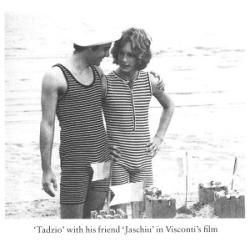
Until Thomas Mann's diaries were posthumously published, it was not well known that he was a pederast, a lover of adolescent boys, or that his most famous work, Death in Venice, was almost autobiographical;  in his own words, "nothing was invented."  So who was the boy "Tadzio" with whom he fell in love in Venice in the summer of 1911?

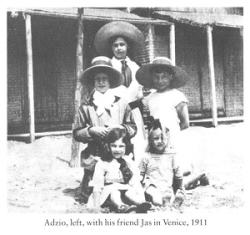
In 1964, an elderly Pole named Wladyslaw Moes came forward to the Polish translator of the novella and said "I am that boy!"  So far as I can gather, no one ever sought to question this sensational revelation, though no one made much of it either until Gilbert Adair had the brilliant idea of writing this book.  

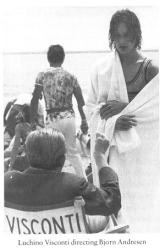
Adair was a gifted writer; his book is witty and very readable, though regrettably peppered with unfair waspish comments, of which two will suffice as examples here.  For noting that his sister used a massive amount of cyanide to kill herself, Mann is said to have shown " an unnerving absence of sibling warmth."  How so?  Luchino Visconti, the other giant in the story thanks to his famous film of the novella, is put down for his "evident, malicious pleasure in showing himself in the process of  inspecting bevies of schoolboys" auditioning for Tadzio's part.  I should think Visconti probably did feel pleasure, but it is not at all evident to me there was anything malicious about it.  To remarks like this, I am tempted to reply with the royal motto "Honi soit qui mal y pense."

More seriously for a book that claims to be a real work of research, I suspect Adair rolled it off in a week or so.  There is no bibliography or footnotes.  No sources are referred to except Moes's daughter and his friend's son, and it appears that interviewing these two was the total sum of his research.  Such information as they could  give ninety years after the event and when the protagonists were all long dead falls largely under the euphemism of "family tradition."  Anyone who has done serious genealogical research inspired by one can attest this is usually distorted and often no more than self-glorifying fantasy.  Adair admits this, but it doesn't stop him reproducing an entirely gushing account of the noble Moes family, beginning with Wladyslaw's "extremely enlightened" grandfather and continuing through his "compassionately liberal" father to the man himself, "evidently capable of charming the birds off trees" (another "evidently" for which no evidence is presented).

My gravest criticism goes however to the heart of the book:  I have serious doubts Moes was Tadzio at all.  The nearest Adair gets to any criticism of Moes is in his daughter's description of his great vanity, presented as an endearing foible.  I see no reason to doubt he visited Venice in childhood, very likely staying in the cosmopolitan Hotel des Bains.  But if this happened when he was ten, as would have to be the case if he were Tadzio, what details would he remember in old age sufficient to identify himself as such?  The month, for example?  I doubt that very much, and since the Moes family were only allowed to retrieve one suitcase of personal possessions from communist confiscation, it would be astonishing if he had documents to support the claim.  Surely it would not be hard for any vain and pampered Pole who remembered visiting Venice in roughly the same era to suspect and then convince himself he was the one soon after described in Visconti's advertising as "the most beautiful boy in the world."

Let us now turn to some of the known discrepancies, bearing in mind we are strictly limited here to such as chance to emerge from Adair's uncritical account.  Given how serious these are, we may expect that far more would have emerged from a cross-examination in the '60s. Bear in mind also that we have the words of both Mann and his widow Katia that, having already decided to write a story about a great writer who succumbs to passion for a youngster and to base the writer physically on the recently deceased composer Mahler, the rest of the story fell into place in detail.  There is therefore no reason to expect discrepancies at all, one reason why Adair's attempted explanations of them come across to me as special pleading.

The most serious discrepancy is that Tadzio was a youth of "about fourteen" in the novella, or "about thirteen" according to Katia, who was there, and later spoke frankly of her husband's pederasty, whereas Moes was a child of ten and six months (Adair first calls him "not quite eleven" and thereafter conveniently drops the "not quite").  The difference between ten and thirteen or fourteen is enormously important.  Mann's diaries abound in evidence of his attraction to pubescent boys, but there is not a shred of evidence to link him to true paedophilia or attraction to pre-pubescent children.  The older age is also that towards which pederasts have typically been attracted since antiquity and the novella is rich in Greek pederastic imagery; the whole canon of Greek literature and art contains not a single reference to erotic attraction to the truly pre-pubescent.

Secondly, Mann is at his most eloquent describing the perfect "godlike beauty" of Tadzio, also described by Katia as a "very charming, beautiful boy."   As Adair admits, pudgy-faced Moes looked like a "lump." To explain this discrepancy, he points out our ideas of beauty are subject to fashion and suggests "that everyone appears to get sexier in proportion as we draw closer to our own era."  It is a fascinating observation and undoubtedly true up to a point, but we are dealing here with extremes which well exceed that point.  The numerous busts of the most celebrated loved boy in history, the Emperor Hadrian's deified Antinous, continue to seduce after nineteen centuries, as do the Davids of Michelangelo and Donatello after five.

These were not the only physical differences  between the two boys.  Tadzio had "twilit grey eyes" and "lovely hair that curled ... about his brows, above his ears, longer still in the neck";  Moes had water-blue eyes and his hair was straight above his brow, covered his ears with a hideous pronged fringe and was not longer in the neck.

Turning to the boys' respective families, Tadzio was the youngest of three children, Moes the fourth of six.   Adair admits on photographic evidence that the actress who played Tadzio's mother in the film "bore no resemblance" to Moes's mother, "but was the very image  of Mann's description of her fictional equivalent."

Moes recalled being stalked by an "old man", but Katia was emphatic later (but too late for Moes to correct his memories) that it wasn't true her 36-year-old  husband followed him around the city: "He didn't pursue him through all of Venice -- that he didn't do".  Isn't this then a typical example of the kind of false memory, created out of what its victim is expected to recollect, often ready to ensnare biographers.

Finally, there is the question of the boy's name, which Mann concluded after hearing called repeatedly was "Tadzio a shortened form of Thaddeus", but is  convolutedly explained by Adair as a mishearing of Adzio, said to be short via Wladzio for Wladyslaw.  It's possible, but I would opt first for the most simple solution, that Mann got it right.

If I had tried to find the real Tadzio, I would have looked for a Thaddeus who was a beautiful fourteen in 1911.  It signifies little that such a claimant hasn't presented himself.  Even if Mann's prognosis that "he is sickly, he will never live to grow up" had turned out to be pessimistic, when Armageddon erupted three summers later he would have been about seventeen and getting ready to join the carnage.  As young officer material, the odds for his survival will sadly not have been high. 


Continue reading..

Online Users
There is currently 1 user online 0 Member(s) | 1 Guest(s)

Welcome, Guest
You have to register before you can post on our site.

Username
  

Password


Search Forums

(Advanced Search)