 |
Milès, né à Byblos des amours d'un marchand et de son esclave de Bythinie, Lidda, se fait rapidement remarquer par sa grande beauté. D'abord destiné à être prêtre au temple d'Adonis, à Attalée, il s'en échappe pour retourner à son pays natal. Il a déjà éveillé l'amour chez Enacrios. Devenu esclave, il est acheté par Scopas l'architecte qui le ramène à Athènes, où il l'affranchit. Il a alors 15 ans. Scopas se meurt d'amour pour Milès, mais celui-ci ne le lui rend pas, tourmenté qu'il est par son rêve de retourner à son pays natal. Sa beauté provoque l'admiration et la passion du peintre Ictinos qui l'utilise comme modèle pour les fresques du temple de Ganymède, construit par Scopas. Il fuit encore avec un inconnu, qui est comme le double de lui-même. Resté seul, il voit le reflet de son image dans l'eau : "Cette image lui souriait pour l'attirer vers elle. Il se pencha encore; soudain il sentit le contact humide et doux de lèvres, plus tiède encore qu'un baiser. N'était-ce pas là l'image du sauveur qui le mènerait dans sa patrie nostalgique par des chemins que nul ne connaissait, maintenant que les humains, tous, lui avaient menti? Aussi, les regards frôlant les vagues. Milès éprouvait-il un singulier plaisir à entendre les voix qui lui parlaient enfin. Car ces voix lui parlaient, disaient les pays d'extase imaginaire où l'on ne souffre plus, où l'on ne pense plus, où l'on ne rêve pas. L'adolescent se penchait encore... Ses doigts qui s'agrippaient au rocher glissèrent...".
L'évocation de la beauté juvénile est omniprésente : "ils croisèrent une théorie de jeunes hommes et d'adolescents dont les tuniques de lin transparentes laissaient voir des formes juvéniles et musclées." En particulier, ces deux belles évocations du jeune Milès nu : "Puis il dégrafa sa tunique dont l'étoffe soyeuse tomba à terre, palpitant autour de lui tel qu'un phalène. Et il demeura ainsi, dans une pose presque pareille à celle du dieu, tandis que les rayons d'or poudraient de lumière chaude la nacre ferme de sa chair. Prolongement fuselé de ses chevilles étroites, les jambes musclées, déliées au genou supportaient comme deux colonnes d'albâtre le torse souple, le ventre plat et légèrement creux où s'affirmait la précoce virilité de Milès. La tête semblait une fleur plus belle épanouie sur le col de cette amphore humaine dont les anses étaient fermées par les deux bras déjà robustes de l'adolescent. Devant cette splendeur et cette immobilité, personne n'élevait la voix comme devant un chef-d'œuvre. Milès avait chanté, dansé et il se montrait dans sa nudité glorieuse..." Milès "dénoua l'étoffe fine qui lui ceignait les reins et sa nudité radieuse apparut. La tête splendide de pureté, avec le front bas tout ombragé de cheveux drus, bouclés sur les yeux clairs, se détachait plus nerveuse encore et plus altière sur le cou veiné qui l'unissait à la poitrine blanche, au torse cambré. Une petite ligne brune faisait collier, séparant du corps pâle le visage et la nuque, mordorés par le soleil. Les épaules un peu étroites, à la peau moirée, indiquaient la grande jeunesse, ainsi que les bras, mal habitués aux violents exercices, et presque trop maigres. Mais les hanches polies, ombrées par la puberté saine, le sexe rond et ferme comme un fruit, les cuisses dures, les mollets élancés disaient quel mâle s'éveillerait dans cet enfant, aux jours de la force prochaine."
L'histoire baigne dans une atmosphère éthérée, dans laquelle les réalités crues de l'amour semblent bien loin. Seules quelques allusions évoquent la sensualité (je n'irai pas jusqu'à dire la sexualité, le mot paraît déplacé dans le monde imaginaire de Fersen !) : "Sous les doigts subtils des pocillateurs, Milès en extase fermait ses beaux yeux. Depuis trois mois qu'il avait été soumis aux purifications, et qu'il apprenait pour affronter l'aéropage le chant des vers et la danse, jamais encore les caresses des esclaves n'avaient été si douces. On l'avait oint d'huiles précieuses et de nards de Syracuse. Ses paupières battaient comme des ailes lasses et son corps radieux était souple, ondoyant et tendre — comme une algue rose." Ecoutons Scopas l'architecte qui se meurt d'amour pour le beau Milès. Son amour sait aussi s'exprimer comme un désir sensuel : "Et lorsque je te regarde, désirable et plus bel encor par ton indifférence, lorsque je sens monter en moi les gestes et les râles du désir, il me semble évoquer la légende du Prométhée, dont, en place des vautours, une colombe dévore le cœur..."
Quote: Miles, born in Byblos to the love of a merchant and his slave from Bythinia, Lidda, quickly became noticed for his great beauty. Initially destined to be a priest at the temple of Adonis, in Attalea, he escaped to return to his native country. He has already awakened love in Enacrios. Having become a slave, he was bought by Scopas, the architect, who brought him back to Athens, where he freed him. He was 15 years old at the time. Scopas is dying of love for Milès, but he does not reciprocate, tormented as he is by his dream of returning to his native country. Its beauty provoked the admiration and passion of the painter Ictinos, who used it as a model for the frescoes of the temple of Ganymede, built by Scopas. He flees again with a stranger, who is like a double of himself. Left alone, he saw the reflection of his image in the water: "This image smiled at him to attract him to it. He bent down again; suddenly he felt the moist and soft touch of lips, even warmer than a kiss. Was this not the image of the savior who would lead him to his nostalgic homeland by paths that no one knew, now that humans, all of them, had lied to him? Also, the eyes brushing against the waves. Did Milès feel a singular pleasure in hearing the voices that spoke to him at last? For these voices spoke to him, told of the countries of imaginary ecstasy where one no longer suffers, where one no longer thinks, where one does not dream. The teenager was still leaning over... His fingers that were clinging to the rock slipped...".
The evocation of youthful beauty is omnipresent: "they came across a theory of young men and adolescents whose transparent linen tunics revealed youthful and muscular shapes." In particular, these two beautiful evocations of the naked young Milès: "Then he unfastened his tunic, the silken fabric of which fell to the ground, throbbing around him like a moth. And so he remained, in a pose almost like that of the god, while the golden rays powdered the firm mother-of-pearl of his flesh with warm light. A tapered extension of his narrow ankles, the muscular legs, loose at the knee, supported like two alabaster columns the supple torso, the flat and slightly hollow stomach where Milès' precocious virility asserted itself. The head seemed like a more beautiful flower blooming on the neck of this human amphora, the handles of which were closed by the two already robust arms of the youth. In the face of this splendour and immobility, no one raised his voice as if he were in front of a masterpiece. Milès had sung, danced and he showed himself in his glorious nudity..." Milès "untied the fine cloth that encircled his loins and his radiant nakedness appeared. The head splendidly pure, with the low forehead all shaded by coarse hair, curly over the light eyes, stood out still more nervous and haughty on the veined neck which united it to the white chest, with its arched torso. A small brown line formed a necklace, separating the face and nape of the neck, bronzed by the sun, from the pale body. The shoulders, a little narrow, with shimmering skin, indicated great youth, as well as the arms, unaccustomed to violent exercises, and almost too thin. But the polished hips, shaded by healthy puberty, the sex round and firm as a fruit, the hard thighs, the slender calves, told what a male would awaken in this child, in the days of the coming strength."
The story is bathed in an ethereal atmosphere, in which the raw realities of love seem far away. Only a few allusions evoke sensuality (I won't go so far as to say sexuality, the word seems out of place in Fersen's imaginary world!): "Under the subtle fingers of the pocillators, Milès in ecstasy closed his beautiful eyes. During the three months since he had been subjected to purifications, and had learned to face the aeropage the singing of verses and dancing, never before had the caresses of slaves been so sweet. He had been anointed with precious oils and spikenards from Syracuse. Her eyelids fluttered like weary wings, and her radiant body was supple, wavy, and tender—like pink seaweed." Let us listen to Scopas, the architect who is dying of love for the handsome Milès. His love also knows how to express itself as a sensual desire: "And when I look at you, desirable and more beautiful by your indifference, when I feel the gestures and groans of desire rising in me, it seems to me to evoke the legend of Prometheus, whose heart is devoured by a dove in place of vultures..."
That will be it for sensuality. In this same passage, it is also another theme that runs through the entire book: the impossible love for a handsome teenager who does not return it. Should we see in this an echo of Fersen's love affair with Nino Cesarini, the young 15-year-old Italian mason to whom he had become attached, perhaps like Scopas, to the young slave Milès, also 15 years old? "Without realizing the fever raised by her beauty, Miles, ignorant of love, ignorant of himself, returned in affection what Enacrios offered him in passion, more obscure and humble." For example, this dialogue between Scopas and the philosopher: "Tell me what must be done to cheer up this child," repeated the anxious old man... I suffer and I love him... -He's too handsome to smile at you." "For a moment the old artist turned his head, thinking that the child was speaking to him. It was just the wind in the leaves..."
We sense Fersen's nostalgia for a time when one could love the beauty of young people. It sounds like a painful reminder of his past disappointments, for simply wanting to live in accordance with his tastes: “However, Milès grew in size and beauty, and Lidda's charming head revived, animated, and seemed to spring from the warm, white neck as from a sublime stem. When Milès passed with Séir through the paved streets of Byblos, and the flat stone resounded under the hoof of the donkey carrying the child, crouching merchants, rich men in litter, Roman legionaries, prophets and beggars turned away to see this radiant apparition. For it was a time when the world worshipped Beauty, when the people absolved Phryne for the splendor of her forms, when Antinous was about to be born at the whim of an Emperor. And all exclaimed: This one will be loved by Zeus! And they lent to the gods of heaven the admiration of the men of earth...”
A lost paradise or a world to be rediscovered: “Oh yes! in the face of this dirty brutality, these animal needs, these hairy or flabby skins, this lack of ideal and youth, how sumptuous, rare and persecuted appeared to him the other Passion, hitherto disdained by him as a compromise and as a crime! The slender images of the Ephebe and similar ephebes danced in the half-light a clear round around his sad forehead, an ambiguous, caressing round set to the sound of a spring or a kiss! And that was happiness without mixture, the present without future!”
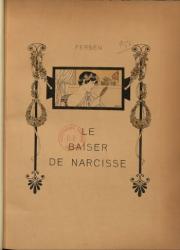
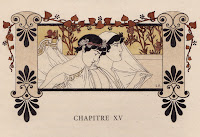
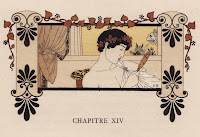
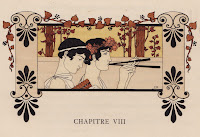
This text first appeared in 1907, in a collection of two short stories: Une Jeunesse. Le Baiser de Narcisse. Paris, Librairie Léon Vanier, éditeur, A. Messein, succr, 1907, in-18, 225 p. In 1912, a new edition of Le Baiser de Narcisse, with illustrations by Ernest Brisset, was published by Léon Michaud, Reims. It is this work that I present today. I was seduced more by the quality of the edition, in particular by the beauty of Ernest Brisset's drawings, than by the text, whose interest is more documentary on a certain way of living and imagining homosexuality at the beginning of the 20th century, even if I'm not insensitive to certain qualities of style, despite its preciousness. Unfortunately, I haven't found much information on this illustrator, who was born in Reims in 1872 and died in Paris in 1933. I did find a 1911 illustration for Moët et Chandon champagne, in the same spirit as those illustrating this book. Is he a lover of Greek beauty?
I'm not going to give a biography of Jacques d'Adelswärd-Fersen here. There are many sites, including a Wikipedia entry in English (click here). A good, well-illustrated summary can be found on the Homodesiribus website. For those who read Spanish, there's another good summary of Fersen on the blog: bajo el signo de libra, from which I've extracted the photos that illustrate this post, in particular this fine portrait whose mischievous little smile I like.
Rappelons qu'en 1904, Fersen rencontre Nino Ceasrini, un jeune italien qui va partager sa vie dans sa villa de Capri. La première édition de 1907 porte cette belle dédicace qui lui est adressée : "à N. C. Plus beau que la lumière romaine. " Celle de 1912 porte une dédicace plus sobre où l'on doit reconnaître ses initiales, avec celle d'Ernest Brisset : "Pour E.B. et N.C. en amitié fervente et fidèle." Les portraits de l'adolescent Milès, par Brisset, n'ont-il pas été inspirés par Nino Cesarini ? Je vous laisse juge à partir de ce portrait par Paul Höcker
|